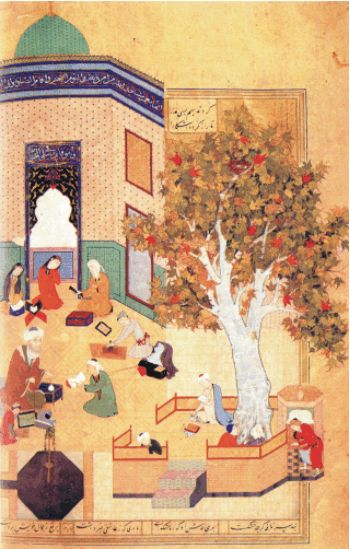
"I rode to the principal school, and found it
a series of little low rooms or open niches, which enclosed a courtyard.
A large fountain or basin for water had been constructed in the centre
of the open space, the corners of the court being surmounted by some high
domes and minarets of coloured tiles similar to those in the Khan's palace.
A mullah superintends each school, and under his supervision there is
a staff of other teachers. The subjects taught are reading, writing and
the Koran; pages of which are committed to memory by the pupils. The teacher
squats beside the hearth in the middle of the room, whilst the boys sit
around him, and learn from his lips verses of scripture.
The parents pay for their children's tuition in corn, a certain number
of measures being given to the instructor in return for his labours. A
crowd followed us about, and some of the people were much surprised, seeing
that I wrote from left to right, instead of from right to left, as I jotted
down my notes in a pocket-book."
Captain Frederick Burnaby 'A Ride to Khiva' 1876
 |
During the period of the khanate there was a total of 124 madrassahs in the Khorezm oasis, with 64 located in Khiva. These Koranic schools of learning were usually built by khans or wealthy citizens wishing to leave a legacy demonstrating their piety. Often built to accommodate large numbers of students, the endowments could be huge. For example, Arminius Vambery notes how a staggering £2500 was donated to the Mohammed Amin Khan Madrassah in 1863.
 |
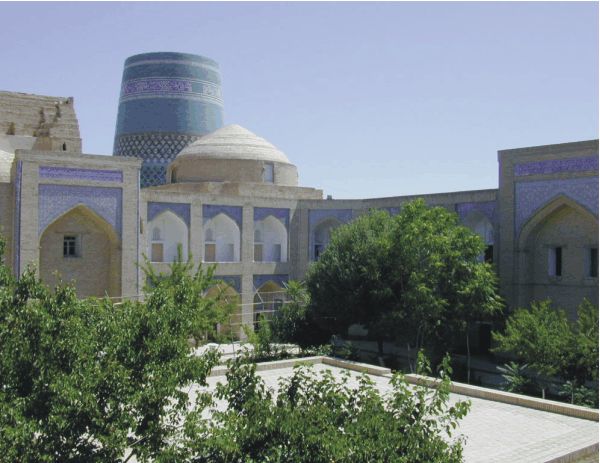
Madrassahs were designed to be inward focused in style. Once through
the impressive front portals and entrance ways, a madrassah would provide
a quiet and open courtyard away from the hustle and bustle of life outside.
Students lived and studied in the cells which surrounded the courtyard,
although there were usually one or two larger rooms next to the main entrance
which were used as meeting places or winter mosques. A madrassah would
also be home to a staff of professors (between three and five), an 'imam'
(Muslim cleric), a 'muezzin' (caller to prayer), a barber to shave heads,
an accountant or two and a couple of servants for menial work.
Madrassahs would take only male pupils who would usually start around
the age of fourteen, having completed preliminary Koranic studies at their
local mosque. Students would live and study at the madrassah usually for
around eight years. However this was not always the case, as Henry Lansdell
notes,
"The course of instruction is not limited as to time. Some of the students stay 30 or 40 years, affirming that if a bird could fly for 30,000 years in a straight line, the distance travelled would scarcely give an idea of the depth of Mohammedan learning."
Henry Lansdell 'Russian Central Asia' 1885
Life within the madrassahs followed a simple routine and a spartan lifestyle,
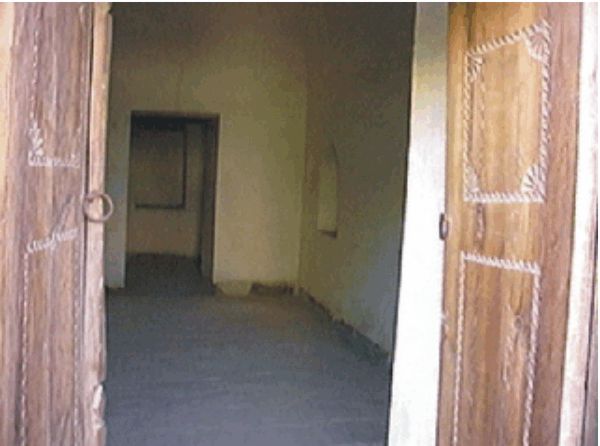 |
"The teaching system of these schools has not the faintest resemblance to ours. A verandah runs round the central court, from which innumerable little doors lead into small windowless cells, whose sole furniture consists of a few felt rugs, a padded quilt, a comb, and a brass water jug. When the hour of instruction comes, two or three pupils from the neighbouring cells gather in one of the tiny rooms and squat round their teacher on the ground, while he reads aloud in a chanting sing-song voice."
Gustav Krist 'Journey through a forbidden land' 1939
Students were given little time for leisure and prohibited from marrying
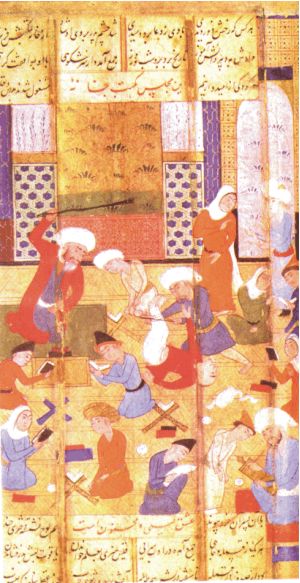
during their time of study. Discipline amongst the younger students was
considered particularly important and miscreants were either beaten over
the head with a stick or held by the feet and whipped on their backsides.
Students were grouped according to intellectual ability and were taught
mathematics and logic, philosophy, Arabic and grammar. However the principle
focus was the study of the Koran. Many students would learn to recite
the whole book from memory and in some madrassahs it was forbidden to
ask the teachers questions regarding religion until students had first
memorised the entire Koran.
Vambery was most unimpressed with the lack of attention given to other
subjects stating,
"Now and then, perhaps, one might be found who would like to busy
himself with poetry and history, but his studies must be in secret, as
it is regarded as a disgrace to devote oneself to any such frivolous subjects."
Arminius Vambery 'Travels in Central Asia' 1864
Ella Christie found methods of blind repetition questionable,
"A man who can say the Koran from end to end or, beginning at any part, can go on repeating it, is deemed a scholar, though he may be utterly unable to translate a chapter and know nothing of Arabic."
Ella R. Christie 'Through Khiva to Golden Samarkand' 1925 (journeyed to Khiva in 1912)
 |
Although students could not necessarily understand the Arabic they chanted and memorised, it was still enough to secure them jobs as 'mullahs' (muslim priests) or teachers and madrassahs continued as the main form of education until the advent of Communism. Thereafter new secular schools were built and all the madrassahs were closed as part of the crack-down on religious activity and in order to provide building materials for collective farms. Those that remained standing were given a variety of other functions. Ella Maillart attempted to enter the Mohammed Amin Khan Madrassah during her trip in 1932 but was unable to do so due to its requisition as a prison. She observed some of the other uses of madrassahs in Khiva.
"In the courtyard of a sombre looking madrassah dyers are at work, their rectangular vats fashioned from one huge piece of leather. Arrested by a muffled rumble, I look through the loophole in the wall of a cell and see a little ass with bony cruppers and blindfold eyes, walking round a room and dragging a millstone after it, which thus grinds the flour."
Ella Maillart 'Turkestan Solo' 1933
Even today none of the madrassahs of Khiva have been restored to their original purpose. Instead they are used as wood workshops, museums, registry offices and one is even a hotel.
 Tour Links:
| Aywans
| Madrassahs | Mausoleums Mosques and Minaretes | Yurts | Tiles |